






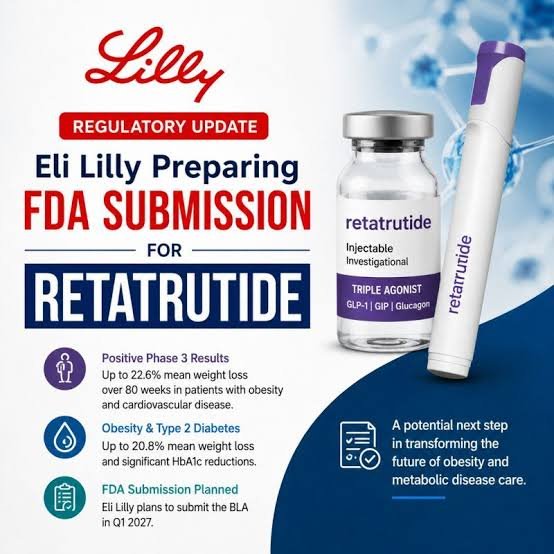
Have you heard about a new weekly injection that may help people lose a substantial amount of body weight? The medicine is called retatrutide, and Eli Lilly and Company is developing it as a treatment for obesity and related health conditions.
The early findings are encouraging. However, there is an important distinction between the weight loss reported in company analyses and the results published in a peer-reviewed medical journal.
As of October 26, 2026, retatrutide has not been approved by the U.S. Food and Drug Administration (FDA). Here is what the clinical evidence shows, what remains uncertain, and why the drug’s safety profile deserves attention.
What Is Retatrutide, And How Does It Work?
Retatrutide is an investigational medicine that activates three hormone receptors: GIP, GLP-1, and glucagon. These pathways help regulate appetite, blood sugar, and the body’s use of energy.
The medicine is being studied as a once-weekly injection. In the TRIUMPH-1 clinical trial, participants started with a 2 mg dose, followed by gradual increases based on their assigned treatment group.
The three target doses were 4 mg, 9 mg, and 12 mg. Researchers are studying whether activating these three pathways together can produce substantial weight loss while improving certain measures of metabolic health.
Unlike medicines that activate only GLP-1 receptors, retatrutide also targets GIP and glucagon receptors. However, this difference alone does not prove that it is safer or more effective than currently approved treatments.
Readers interested in the broader treatment category can also explore this guide to oral GLP-1 treatment, which explains how oral medicines differ from weekly injections.
What Did The Main Phase III Trial Find?
The main obesity study, TRIUMPH-1, enrolled 2,339 adults with obesity or overweight and at least one weight-related health condition. Participants did not have diabetes.
Researchers randomly assigned participants to receive retatrutide at 4 mg, 9 mg, or 12 mg, or a placebo. The treatment period lasted 80 weeks.
The retatrutide Phase 3 results showed substantial average weight reductions across all three active treatment groups.
| Treatment group | Average weight reduction at 80 weeks, efficacy analysis |
|---|---|
| Retatrutide 4 mg | 19.0% |
| Retatrutide 9 mg | 25.9% |
| Retatrutide 12 mg | 28.3% |
| Placebo | 2.2% |
Source: Eli Lilly’s reported TRIUMPH-1 efficacy analysis.
The 12 mg group recorded the largest average reduction. The company also reported that 62.5% of participants receiving this dose lost at least 25% of their starting body weight, while 45.3% lost at least 30%.
Waist circumference decreased by an average of 24.1 cm in the 12 mg group. This is a useful additional measurement because waist size provides information about abdominal fat that body weight alone cannot show.
Still, the retatrutide weight loss figures represent averages across groups. They do not predict exactly how much any individual will lose.
Why Are Two Different Weight-Loss Figures Reported?
The peer-reviewed TRIUMPH-1 study, published in the New England Journal of Medicine on September 29, 2026, reported an average weight reduction of 25.0% at the 12 mg dose. That is lower than the 28.3% figure in Lilly’s efficacy analysis.
The published treatment-regimen analysis reported these results:
| Treatment group | Average weight change at 80 weeks |
|---|---|
| Retatrutide 4 mg | −17.6% |
| Retatrutide 9 mg | −23.7% |
| Retatrutide 12 mg | −25.0% |
| Placebo | −3.9% |
Negative percentages indicate weight loss.
The difference comes from the statistical methods used to analyse the trial. The efficacy estimand estimates the treatment effect under specified assumptions about continued treatment and other weight-management interventions. The treatment-regimen analysis addresses a different set of circumstances.
Neither percentage should be presented without its statistical context. They are estimates answering different questions, rather than evidence that one report contradicts the other.
When reporting the retatrutide Phase 3 results, the peer-reviewed estimate should be identified clearly, with the company’s efficacy estimate presented separately. This gives readers a more accurate picture of what the study found.
What Happened During The Two-Year Extension?
Lilly also reported results from a selected group of participants followed for an additional 24 weeks, bringing their total treatment period to 104 weeks.
Among participants with a baseline body mass index (BMI) of at least 35 who completed the main study and tolerated their assigned treatment, the 12 mg group achieved an average weight reduction of 30.3%.
This finding is encouraging, but it needs context. The extension included selected participants who completed the original trial and met specific eligibility requirements. It does not establish that everyone starting retatrutide can expect the same result after two years.
How Did Retatrutide Perform In People With Type 2 Diabetes?
TRIUMPH-2 examined adults with obesity or overweight and type 2 diabetes. This population is important because weight management can be more challenging when diabetes is also present.
In Lilly’s efficacy analysis at 80 weeks, the results were:
| Dose | Average weight reduction | Average HbA1c reduction |
|---|---|---|
| 4 mg | 12.7% | 1.4 percentage points |
| 9 mg | 19.1% | 1.6 percentage points |
| 12 mg | 20.8% | 1.5 percentage points |
| Placebo | 4.0% | 0.2 percentage points |
HbA1c is a blood test that reflects average blood glucose over approximately two to three months. A reduction generally indicates improved blood sugar control, although individual targets vary.
The retatrutide weight loss results in TRIUMPH-2 were lower than those in TRIUMPH-1. However, the populations differed, so the percentages should not be compared as if the participants had the same health conditions.
The improvements in HbA1c also do not mean that retatrutide cures diabetes. Any future use in people with diabetes would require careful consideration of other medicines, blood glucose levels, and potential treatment risks.
What About People With Cardiovascular Disease?
TRIUMPH-3 enrolled adults with severe obesity and established cardiovascular disease, with or without type 2 diabetes.
At 80 weeks, participants receiving the highest studied dose had an average weight reduction of 22.6% in Lilly’s efficacy analysis.
This trial provides information about weight loss in a group with additional health risks. However, weight reduction alone does not establish that a medicine prevents heart attacks or strokes. Cardiovascular outcomes must be evaluated separately, and the study’s findings should not be overstated.
What Are The Most Common retatrutide side effects?
The trials found that digestive problems were the most frequently reported adverse events. Their frequency generally increased with higher doses, although not every event followed the same pattern.
The TRIUMPH-1 results were as follows:
| Adverse event | 4 mg | 9 mg | 12 mg | Placebo |
|---|---|---|---|---|
| Nausea | 28.6% | 38.4% | 42.4% | 14.8% |
| Diarrhea | 25.2% | 34.1% | 32.0% | 13.5% |
| Constipation | 23.8% | 25.9% | 26.1% | 10.9% |
| Vomiting | 10.6% | 22.8% | 25.3% | 4.8% |
These rates describe participants in one controlled trial. They are not a guarantee of what a future patient would experience.
Can The Side Effects Cause Other Problems?
Nausea, diarrhea, and vomiting can make it harder to maintain adequate fluid intake. In some circumstances, fluid loss can lead to dehydration and kidney problems.
Researchers also reported dysesthesia, which means unusual skin sensations such as tingling or burning. This occurred in 5.1% of participants taking 4 mg, 12.3% taking 9 mg, and 12.5% taking 12 mg, compared with 0.9% in the placebo group.
Urinary tract infections were also reported. Lilly stated that the dysesthesia and urinary tract infection events were generally mild to moderate, and most resolved during treatment.
In TRIUMPH-1, treatment discontinuation because of adverse events occurred in 4.1% of participants taking 4 mg, 6.9% taking 9 mg, and 11.3% taking 12 mg. The rate was 4.9% with placebo.
These findings show why weight-loss results and treatment tolerability must be considered together. The higher dose produced greater average weight loss, but more participants stopped treatment because of adverse events.
Anyone enrolled in a clinical trial should report new or worsening symptoms to the study team. Severe or persistent abdominal pain, repeated vomiting, signs of dehydration, or symptoms of a serious allergic reaction require prompt medical attention.
Is Retatrutide FDA-Approved?
No. As of October 26, 2026, retatrutide remains investigational and is not approved for public use by the FDA.
According to Eli Lilly and Company, the company plans to submit a U.S. Biologics License Application in the first quarter of 2027.
This is a planned regulatory submission, not a confirmed approval date. The FDA must assess the available evidence before deciding whether the medicine can be marketed for its proposed use.
Retatrutide should not be purchased from websites selling research peptides or unapproved injections. Buyers cannot reliably confirm the identity, purity, strength, or safety of such products. They are not a safe substitute for an approved prescription medicine.
People seeking obesity treatment now can speak with a healthcare professional about approved medicines, nutrition support, physical activity, and other appropriate treatment options.
What Can The Current Evidence Not Tell Us?
Despite the encouraging findings, several questions remain unanswered.
First, TRIUMPH-1 compared retatrutide with a placebo, not directly with approved medicines such as semaglutide or tirzepatide. It therefore cannot establish whether retatrutide is more effective than those treatments.
Second, the results come from a clinical development program sponsored by the manufacturer. Peer review adds an important level of scrutiny, but further regulatory assessment, independent research, and longer follow-up remain valuable.
Third, studies lasting 80 to 104 weeks cannot establish every potential long-term risk. Researchers will need additional data to understand how safety and effectiveness change with prolonged use.
Finally, it remains uncertain how much weight people might regain after stopping retatrutide. Results from other obesity medicines suggest that weight regain can occur after treatment ends, but retatrutide’s longer-term outcomes must be established through evidence specific to this medicine.
The retatrutide Phase 3 results provide a strong reason to continue studying the drug, but they do not establish that it is appropriate for every person with obesity.
What Should You Do Now?
If you are considering medical treatment for obesity, speak with a qualified healthcare professional. They can review your health conditions, current medicines, treatment goals, and eligibility for approved therapies or a clinical trial.
People with diabetes should be especially careful about changing insulin or other blood sugar medicines without medical advice. Changes in food intake and weight can affect glucose levels and treatment needs.
Do not use products sold online as retatrutide outside legitimate clinical trials. Seek medical care for severe abdominal pain, persistent vomiting, or signs of dehydration, such as dizziness and very little urine.
The most useful approach is to follow peer-reviewed research and official regulatory announcements rather than claims promising guaranteed weight loss or immediate access to an unapproved medicine.
Frequently Asked Questions
1. Is Retatrutide The Same As Ozempic Or Zepbound?
No. Ozempic contains semaglutide, while Zepbound contains tirzepatide. Retatrutide acts on GIP, GLP-1, and glucagon receptors and remains investigational. The studies discussed here do not provide a direct comparison with those medicines.
2. How Much retatrutide weight loss Can A Person Expect?
There is no reliable way to predict an individual’s result from a trial average. In TRIUMPH-1, the average reduction at 12 mg was 25.0% in the published treatment-regimen analysis and 28.3% in Lilly’s efficacy analysis. Individual results can differ considerably.
3. What Are The Most Common retatrutide side effects?
Nausea, diarrhea, constipation, and vomiting were the most frequently reported digestive adverse events in TRIUMPH-1. Their frequency varied by dose, and some participants discontinued treatment because of adverse events.
4. Can Someone Join A Retatrutide Clinical Trial?
Clinical trials are the legitimate route for accessing an investigational medicine such as retatrutide. Eligibility depends on the specific study and may involve BMI, medical history, existing conditions, and previous treatment. Not every trial is recruiting at all times.
5. When Could Retatrutide Become Available?
Lilly plans to submit its U.S. application in the first quarter of 2027. The medicine would still need to pass the regulatory review process before it could be approved. No confirmed public launch date is available.
6. Is Retatrutide Being Studied For Conditions Other Than Obesity?
Yes. Lilly is also investigating its potential use for type 2 diabetes, knee osteoarthritis pain, obstructive sleep apnea, chronic low back pain, cardiovascular and renal outcomes, and metabolic dysfunction-associated steatotic liver disease. These research programs do not mean retatrutide is approved for any of these conditions.