






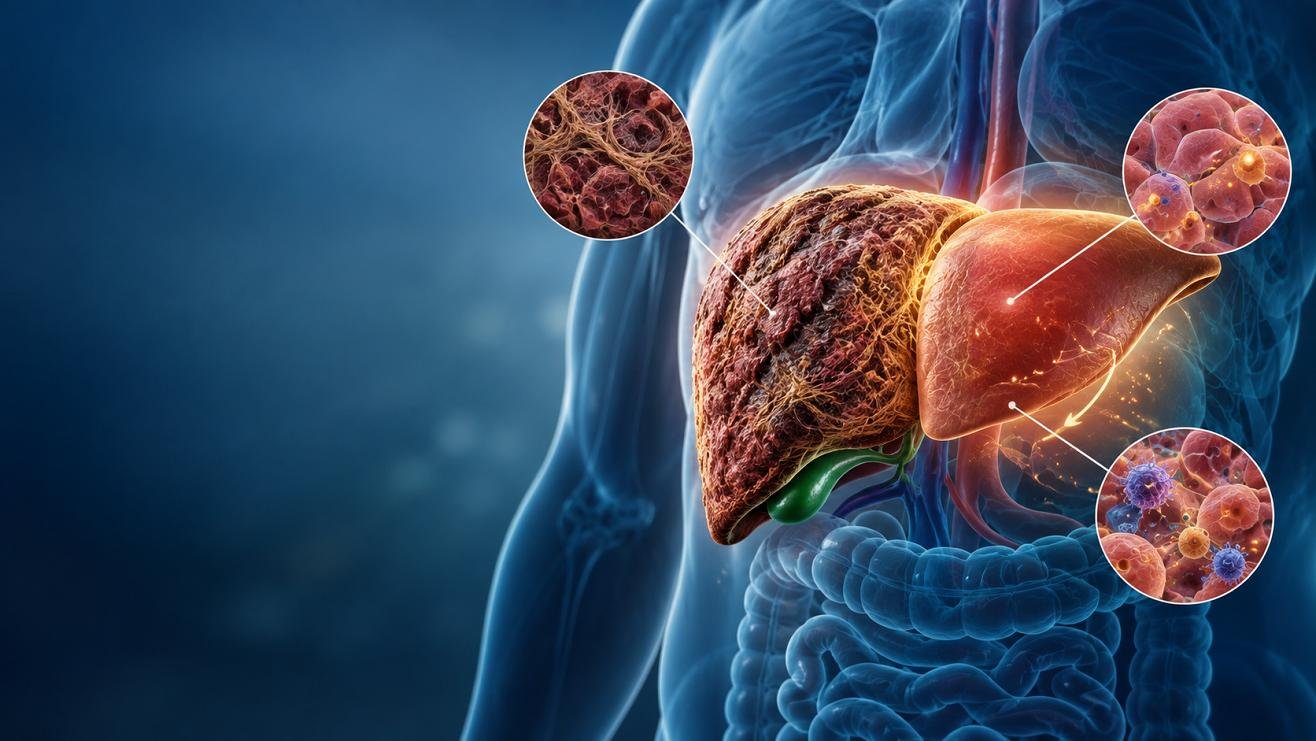
Stopping alcohol is supposed to give the liver a chance to recover. And often, it does. But some people become sober, follow treatment, and still watch their liver function worsen or remain dangerously impaired.
That contradiction has puzzled liver researchers for years.
A study published in Nature Communications has now identified a possible explanation. In severe alcohol-associated liver disease, damaged liver cells may begin the repair process but fail to finish it. Instead, they become trapped in what researchers describe as a liver regenerative limbo, a dysfunctional middle state between a mature liver cell and a properly regenerating cell.
The research, brought to wider attention on August 31, 2026, offers an important new explanation for why liver healing after quitting alcohol is not always as straightforward as simply removing alcohol from the body.
The Liver Can Start Repairing Itself and Still Fail
The liver has an unusual ability to regenerate. After injury, surviving hepatocytes, the liver’s main working cells, can temporarily change their state, divide, and later return to a mature form.
That sequence matters.
A healthy repair process is roughly this:
Mature liver cell → temporary regenerative state → cell division → mature functioning liver cell again.
In advanced alcohol-associated liver disease, researchers found that this sequence can break down in the middle.
The cells start moving away from their mature identity, but they do not become effective regenerative cells. Nor do they return to being healthy, mature hepatocytes. They are left in between.
This liver regenerative limbo is particularly important because a liver filled with these cells gradually loses functional capacity. The remaining healthy cells are forced to carry more of the workload. Those cells may then attempt to regenerate too, creating a destructive cycle.
That is why alcohol liver disease recovery may sometimes stall even after alcohol consumption has stopped.
The New Finding Points to RNA Splicing Errors
The researchers traced much of the problem to RNA splicing.
RNA carries genetic instructions that cells use to produce proteins. Before many of those instructions can be used, the RNA has to be edited through a process called splicing. Different pieces are removed or joined, producing the correct instructions for a particular protein.
In diseased livers, researchers found widespread RNA missplicing.
The problem was not necessarily that liver cells lacked proteins altogether. In some cases, proteins were being produced but were ending up in the wrong part of the cell.
That is a subtle difference, but a crucial one.
The research identified a protein called ESRP2 as an important part of the process. ESRP2 helps control RNA splicing in mature liver cells. When its levels fall, key RNA messages can be assembled incorrectly.
According to the original research published in Nature Communications, these splicing defects can affect proteins involved in WNT and Hippo signaling, two pathways that are important for normal liver regeneration.
Inflammation May Be Keeping the Liver Stuck
Why does ESRP2 fall in the first place?
The researchers linked the process to the inflammatory environment inside an alcohol-damaged liver.
Advanced alcohol-associated liver disease can involve high levels of inflammatory and fibrotic signaling. Factors including TGF-β may suppress the ESRP2-driven splicing program. The result is not simply an injured liver. It is a liver environment that may actively interfere with the cells’ ability to complete regeneration.
Actually, this may be one of the most significant aspects of the discovery. It changes the question from “Why isn’t the liver trying to heal?” to something more specific:
Why is the liver’s repair program getting interrupted halfway through?
That distinction could eventually matter for treatment. The researchers were able to improve normal splicing in laboratory experiments by blocking an inflammatory signaling pathway, although this does not mean that an approved treatment now exists for patients.
For now, the findings should be viewed as a promising research direction, not as proof of a new cure for liver regenerative limbo.
Does This Mean the Liver Cannot Heal After Quitting Alcohol?
No. And this is where the research needs careful interpretation.
Liver healing after quitting alcohol depends heavily on how much structural damage already exists.
Alcohol-related fatty liver can often improve with sustained abstinence. Inflammation may also improve substantially in some people. But fibrosis and cirrhosis involve scar tissue, and advanced cirrhosis may not fully reverse even when alcohol is completely stopped.
The new research adds another possible factor. Severe disease may involve a cellular failure of regeneration, meaning the liver is not simply waiting passively for time to heal it.
It is worth separating this from the broader issue of fat accumulation in the liver. Alcohol-associated steatosis and metabolic fatty liver are not identical, even though both involve hepatic fat and can progress to inflammation and fibrosis. Daily Health Pro’s guide to Rapid Weight Loss and Fatty Liver explains how rapid fat mobilization and nutritional stress can affect liver health through a different pathway.
Symptoms That Can Persist or Worsen After Alcohol Stops
Symptoms alone cannot determine whether the liver is regenerating. Some serious liver diseases produce few symptoms until it is advanced.
Possible symptoms include:
- Persistent fatigue
- Loss of appetite or nausea
- Pain or discomfort in the upper-right abdomen
- Jaundice, causing yellowing of the skin or eyes
- Swelling in the abdomen or legs
- Easy bruising or bleeding
- Confusion, memory problems, or changes in alertness
Confusion in advanced liver disease can indicate hepatic encephalopathy and requires medical assessment. Vomiting blood, passing black stools, severe abdominal swelling, fainting, or rapidly worsening jaundice should be treated as urgent medical problems.
How Doctors Check Whether Alcohol-Related Liver Damage Is Improving
The alcohol liver disease recovery process cannot be measured by how healthy someone feels after a few weeks without alcohol.
Doctors may use liver blood tests, including AST, ALT, bilirubin, albumin, and tests related to blood clotting. Imaging can help identify structural changes. Ultrasound-based elastography may be used to estimate liver stiffness and the extent of fibrosis.
In selected cases, a liver biopsy may still be necessary.
Doctors also look at the bigger clinical picture. Liver blood tests can improve while significant fibrosis remains. Conversely, a person with advanced cirrhosis may need monitoring for complications even if they have remained abstinent for years.
That is one reason liver healing after quitting alcohol should not be confused with a quick “liver detox.” There is no supplement that can reliably switch off fibrosis, reverse cirrhosis, or correct the RNA-splicing defects described in the new research.
What Treatment Actually Involves
The foundation remains complete alcohol abstinence. For someone physically dependent on alcohol, withdrawal can be medically dangerous and should not always be managed alone.
Treatment may also include nutritional support, management of alcohol use disorder, treatment for complications of cirrhosis, and, in severe cases, evaluation for liver transplantation.
The American Association for the Study of Liver Diseases provides clinical guidance on alcohol-associated liver disease and the management of serious liver complications.
One practical point is often missed: abstinence is necessary, but it does not automatically mean that every liver has reached the same stage of recoverability. That is exactly why the new liver regenerative limbo research matters.
Why This Discovery Could Change Future Treatment
Researchers may eventually use abnormal RNA-splicing patterns as biomarkers to identify patients whose livers are failing to regenerate properly.
Future treatment approaches might aim to reduce the inflammatory signals that suppress ESRP2 or correct specific splicing defects. But those possibilities remain experimental.
Still, the discovery provides something medicine did not previously have: a more precise explanation for why some damaged livers appear to enter recovery but never quite make it through the process.
Frequently Asked Questions
Can the liver repair itself after you stop drinking?
Yes, depending on the stage and type of damage. Fatty liver and some inflammatory changes can improve substantially with abstinence, while advanced fibrosis and cirrhosis may persist.
How long does liver healing after quitting alcohol take?
There is no single timeline. Early improvements may occur within weeks, but fibrosis assessment and long-term recovery can take much longer. Advanced disease requires ongoing medical monitoring.
Can liver blood tests become normal even if there is still scarring?
Yes. Improved blood tests do not necessarily prove that fibrosis or cirrhosis has disappeared.
Is liver regenerative limbo an official medical diagnosis?
Not at present. It is a descriptive term used to explain the abnormal quasi-progenitor-like state identified in the new research.
Can supplements restart liver regeneration?
There is currently no proven supplement that can restart failed liver regeneration, reverse cirrhosis, or correct the RNA-splicing abnormalities identified in this study.
Does this research mean alcohol-related liver disease cannot be reversed?
No. The findings explain one potential mechanism behind failed regeneration in severe disease. Many forms and stages of alcohol-related liver injury can improve after sustained abstinence.
The Bigger Message Is More Complicated Than “The Liver Always Heals”
The liver is remarkably resilient, but resilience is not the same as guaranteed recovery.
For years, the public conversation around alcohol liver disease recovery has often been reduced to a simple timeline: stop drinking, wait, and let the liver repair itself. The new research suggests that severe disease can be biologically more complicated. In some cases, the repair process itself may become disorganized.
That should not be interpreted as hopelessness. It does the opposite. Understanding why regeneration fails gives researchers a specific problem to target.
And perhaps that is the real significance of this finding. Scientists may finally be moving from merely observing failed recovery to understanding the cellular machinery that keeps the damaged liver from finishing the job.