






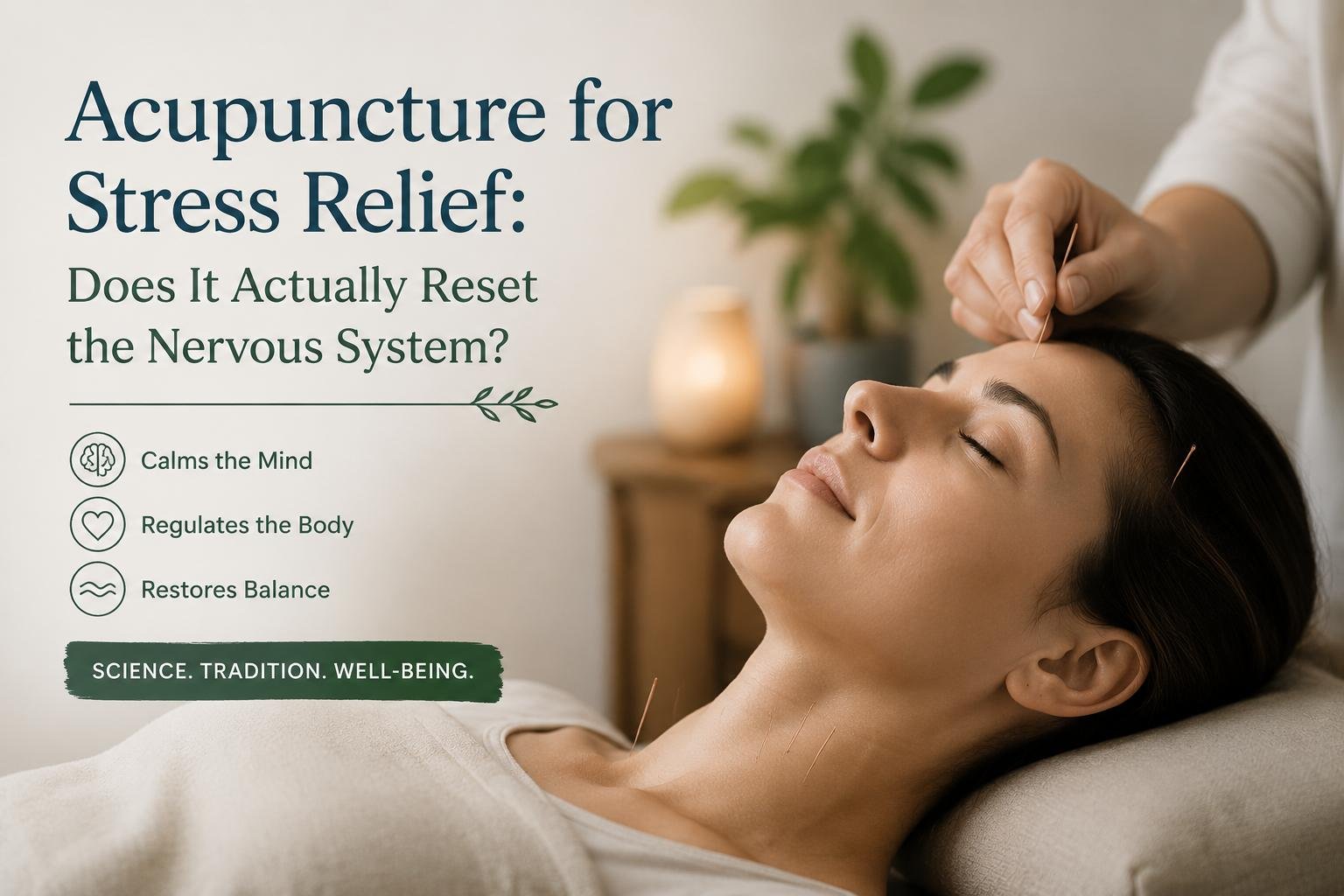
30 seconds summary
- Acupuncture is a traditional therapy that may help reduce stress by influencing the nervous system. It is thought to activate the parasympathetic “rest and digest” response, lower stress hormones like cortisol, and promote the release of calming neurochemicals such as endorphins and serotonin. While it doesn’t literally “reset” the nervous system, research suggests it can help rebalance stress responses and improve relaxation.
- Many people report feeling calmer, sleeping better, and experiencing reduced anxiety after sessions.
- However, scientific evidence is still mixed, and results can vary from person to person. Overall, acupuncture is best seen as a supportive tool for stress management rather than a standalone cure.
Stress is no longer an occasional experience for most people; it has become a constant background condition of modern life. Work pressure, financial concerns, poor sleep, digital overload, and social demands all keep the nervous system in a prolonged state of activation. Over time, this can shift the body into what is often described as a chronic “fight-or-flight” mode, governed by the sympathetic nervous system. In this state, heart rate increases, cortisol levels remain elevated, digestion slows, and mental clarity often declines.
Because of this widespread issue, many people look for non-pharmaceutical ways to regulate stress. One of the most discussed traditional approaches is acupuncture. But a key question remains: can acupuncture actually “reset” the nervous system, or does it simply provide temporary relaxation?
This article explores how acupuncture is believed to work, what modern research suggests, and whether an Acupuncture treatment can meaningfully influence stress physiology.
Understanding the Nervous System and Stress Response
To understand acupuncture’s potential effects, it helps to understand how stress operates in the body.
The autonomic nervous system has two primary branches:
- Sympathetic nervous system (SNS): Activates the “fight or flight” response
- Parasympathetic nervous system (PNS): Promotes “rest and digest” recovery states
When stress becomes chronic, the sympathetic system can become overactive, while parasympathetic activity becomes under-engaged. This imbalance is associated with symptoms such as:
- Anxiety and irritability
- Muscle tension and headaches
- Digestive issues
- Sleep disturbances
- Fatigue despite rest
The idea behind many stress-reduction therapies, including acupuncture, is not to eliminate stress but to restore balance between these two systems.
What Is Acupuncture and How Is It Traditionally Understood?
Acupuncture is a practice rooted in Traditional Chinese Medicine (TCM), which has been used for thousands of years. It involves inserting very fine needles into specific points on the body, known as acupoints. These points are believed in TCM to regulate the flow of “Qi” (energy) along meridians.
From a modern biomedical perspective, Qi is not a measurable substance. However, researchers attempt to explain acupuncture through physiological mechanisms such as:
- Nervous system modulation
- Endorphin release
- Blood flow regulation
- Inflammatory pathway changes
- Brain activity shifts observed in imaging studies
In other words, while the traditional explanation is energetic, modern interpretations focus on neurobiological responses.
How Acupuncture May Influence the Nervous System
One of the most discussed scientific theories is that acupuncture interacts directly with the autonomic nervous system.
1. Activation of the Parasympathetic System
Some studies suggest that acupuncture can stimulate the vagus nerve, a key component of the parasympathetic system. Activation of this pathway is associated with:
- Lower heart rate
- Reduced blood pressure
- Improved digestion
- A sense of calm
If this effect is consistent, it could explain why many people report feeling deeply relaxed after sessions.
2. Regulation of Stress Hormones
Stress is closely tied to cortisol, a hormone released by the adrenal glands. Research has indicated that acupuncture may help reduce elevated cortisol levels in some individuals, although results are mixed depending on study design and patient conditions.
3. Endorphin and Neurotransmitter Release
Acupuncture may stimulate the release of:
- Endorphins (natural painkillers)
- Serotonin (mood regulation)
- Dopamine (motivation and reward)
These neurochemicals play a significant role in emotional balance and stress perception.
4. Brain Activity Changes
Functional MRI studies have shown that acupuncture can influence activity in brain regions involved in:
- Emotional regulation
- Pain perception
- Stress response
- Attention and awareness
These findings suggest that acupuncture is not just a physical intervention but may also affect central nervous system processing.
Does Acupuncture “Reset” the Nervous System?
The phrase “reset the nervous system” is often used in wellness discussions, but it is not a formal scientific term. The nervous system does not reset like a computer. Instead, it adapts dynamically based on ongoing signals and environmental input.
However, acupuncture may contribute to what could be described as a functional recalibration of stress responses.
Rather than resetting the system entirely, it may:
- Reduce sympathetic overactivation
- Enhance parasympathetic tone
- Improve the body’s ability to return to baseline after stress
- Increase stress resilience over time
So, while “reset” is an oversimplification, there is some plausibility to the idea that acupuncture helps the nervous system become more balanced.
What Happens During an Acupuncture Treatment Session?
A typical Acupuncture treatment session begins with a consultation. The practitioner may ask about sleep, digestion, emotional state, and stress levels. Based on this assessment, specific acupoints are selected.
Thin needles are then inserted into targeted areas such as:
- Forehead or scalp
- Wrists and arms
- Legs and feet
- Back or shoulders
Most people report minimal pain—often described as a slight tingling, pressure, or dull sensation. Once the needles are placed, the patient usually rests for 20–40 minutes in a calm environment.
Many individuals report:
- Deep relaxation
- Drowsiness
- Emotional release
- Reduced mental “noise”
These effects contribute to the perception that acupuncture calms the nervous system.
Scientific Evidence: What Do Studies Say About Stress Relief?
Research on acupuncture for stress and anxiety is growing, but still not fully conclusive.
Positive Findings
Some clinical trials and meta-analyses suggest that acupuncture may:
- Reduce anxiety symptoms in certain populations
- Improve sleep quality
- Lower perceived stress levels
- Support relaxation in chronic pain patients
Mixed or Inconclusive Results
Other studies highlight limitations:
- Placebo effects are difficult to rule out
- Variability in acupuncture techniques makes standardization hard
- Some trials show only small or short-term benefits
- Not all patients respond equally
Overall, evidence suggests acupuncture may be helpful, but it is not a standalone cure for chronic stress disorders.
The Role of the Placebo and Mind-Body Interaction
One important factor in acupuncture research is the placebo effect. However, calling it “just a placebo” may oversimplify what is happening.
The placebo response itself involves real neurological processes, including:
- Expectation-driven dopamine release
- Reduced pain perception
- Changes in brain connectivity
In acupuncture, additional elements may enhance this response:
- Calm environment
- Therapeutic touch
- Structured rest period
- Practitioner attention and care
These factors can all contribute to stress reduction, regardless of whether needle placement has specific physiological effects.
Limitations and Considerations
While acupuncture is generally considered safe when performed by trained professionals, it is not suitable for everyone or every condition.
Key considerations include:
- It should not replace medical treatment for severe anxiety or depression
- Results vary widely between individuals
- Multiple sessions are usually needed for noticeable effects
- Costs may accumulate over time
- Quality of practitioner training matters significantly
Additionally, expectations should be realistic. Acupuncture is more likely to support stress management rather than eliminate stress.
Integrating Acupuncture with Other Stress-Relief Methods
For best results, acupuncture is often used as part of a broader stress management strategy. This may include:
- Regular physical exercise
- Mindfulness or meditation
- Breathing techniques
- Sleep hygiene improvement
- Nutritional support
- Therapy or counseling when needed
When combined with these approaches, acupuncture may enhance overall emotional regulation and recovery capacity.
Conclusion
The idea that acupuncture can “reset” the nervous system is more metaphorical than literal. The nervous system is not a switch that can be turned off and on again. However, evidence suggests that acupuncture may help shift the body toward a more balanced state by influencing stress pathways, autonomic regulation, and neurochemical activity.
A well-conducted Acupuncture treatment can promote relaxation, reduce stress perception, and potentially improve resilience to future stressors. While scientific research is still evolving, current findings support its role as a complementary therapy rather than a standalone solution.