






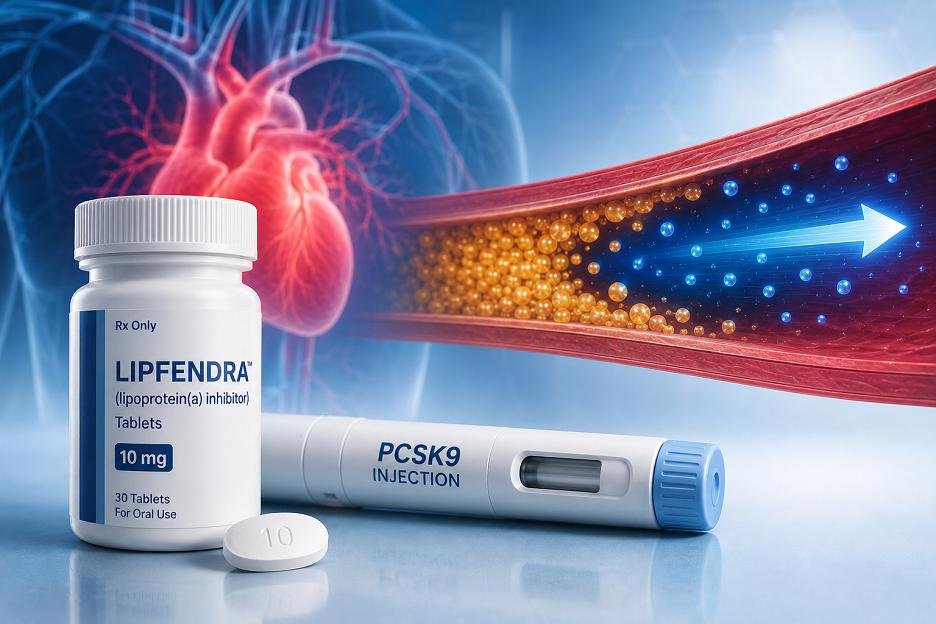
High cholesterol is one of those problems that can sit quietly for years and still do damage. No pain. No dramatic warning. Just slowly rising risk. That is why this approval matters so much. The FDA has now cleared a first-of-its-kind pill that targets PCSK9, a pathway long handled by injections, and it gives doctors another tool for people whose numbers stay stubbornly high despite standard care. The drug is Lipfendra, the first oral PCSK9 inhibitor approved in the U.S., and it arrives as a high-cholesterol pill rather than another shot.
What The FDA Actually Approved
The FDA approved Lipfendra on July 17, 2026, as an add-on to diet and exercise for adults with hypercholesterolemia, including people with heterozygous familial hypercholesterolemia, or HeFH. That is a meaningful detail. This is not being positioned as a casual wellness drug or a replacement for basic treatment. It is meant for adults who still need more LDL lowering even after doing the usual, sensible things like statins, diet changes, and exercise. In plain English, it is for the people whose cholesterol keeps refusing to cooperate. The agency also noted that this is the first oral PCSK9 inhibitor and that PCSK9 drugs had previously been available only as injectables.
For readers who want the official source, the FDA announcement is the clearest place to start: the agency explains the approval, the patient group, and the clinical data behind it in one place. That matters because early headlines can overstate what a new drug does. The actual approval is narrower and more careful than the hype around it. This is a new option, not a miracle shortcut. And yes, it is Lipfendra, which is being discussed everywhere now as the first high cholesterol pill of its kind.
Why Doctors Are Paying Attention
Here is the interesting part. A lot of cholesterol medicine already exists. Statins are the backbone. Ezetimibe is common. Injectable PCSK9 drugs have been around for years. So why all the excitement? Because a daily pill changes the experience of treatment in a very practical way. Some patients dislike injections. Some struggle with access. Some simply do not keep up with a shot schedule. A pill may sound small, but in real life it can be the difference between treatment starting quickly and treatment getting delayed for months.
That is why the approval is being talked about as more than a technical milestone. It may improve adoption for people who need more intensive LDL lowering but have not moved forward with injectable therapy. The FDA also said the drug provides an additional treatment option for adults who require further LDL-C reduction despite existing therapies. In other words, the class has moved from needle-based to pill-based, and that shift could matter a lot in everyday care. Lipfendra is still the headline, but the deeper story is access, convenience, and the possibility of getting more high-risk patients treated earlier with an oral PCSK9 inhibitor instead of waiting until things get worse.
What The Trials Showed
This is where the evidence gets more concrete. The FDA said approval was based on two randomized, double-blind, placebo-controlled trials involving 3,207 adults with hypercholesterolemia, including patients with and without HeFH, all on maximally tolerated statin therapy. In the ASCVD or high-risk group, the mean baseline LDL-C was 96 mg/dL, and treatment led to about a 56% LDL reduction at 24 weeks versus placebo. In the HeFH study, the mean baseline LDL-C was 119 mg/dL, and the reduction was about 59% at 24 weeks versus placebo. Those are large drops. Not modest. Large. And they are the reason people are suddenly talking about this high cholesterol pill as a serious new cardiovascular tool rather than just another incremental option.
A reputable study source is the New England Journal of Medicine report on the oral PCSK9 inhibitor enlicitide, which aligns with the FDA’s summary and shows the same basic pattern of LDL lowering. That matters because the approval is not built on theory alone. It is built on trial data that showed the drug can push LDL down substantially on top of background therapy. That is the kind of result clinicians notice. And still, there is a careful line here: the pill lowers LDL very well, but we do not yet have outcomes data proving it reduces heart attacks or strokes. That part is still being studied. So the drug is promising, but not a finished story.
Safety, Side Effects, And Practical Questions
The FDA said the safety profile was broadly similar to placebo in one trial, while in the HeFH study the most common side effects that appeared more often than placebo were diarrhea and dizziness. Discontinuation rates because of adverse reactions were comparable between treatment and placebo groups. That is reassuring, though of course long-term use in wider real-world populations will tell us more. It is one thing for a drug to look fine in trials. It is another to hold up once thousands of patients start using it in ordinary life, with all the messy details that come with that. Lipfendra is a strong LDL-lowering option, but it is still part of a larger treatment plan rather than a stand-alone answer.
Reuters also reported that Merck said an outcomes trial is ongoing to study whether the medicine lowers cardiovascular events such as heart attack and stroke. That is the big unanswered question. LDL lowering is important, very important, but patients and doctors still care about the outcome at the end of the road. Does the risk actually fall? Does the person stay healthier longer? Those answers usually take time, and they matter more than the marketing language around any new oral PCSK9 inhibitor. For now, the approval is about cholesterol control, not a proven event-reduction claim.
Where It Fits In Real Life
In everyday practice, this is likely to sit above the first-line basics, not beside them. Statins are still the starting point for most patients with elevated risk. Some people also need ezetimibe. Some need injectables. Now there is another branch in the path. That means a cardiologist or primary care doctor may have a more comfortable conversation with a patient who has been dragging their feet about shots. You can almost picture the moment: a patient who has tried and failed to get LDL down for years, and then finally hears there is a pill that works through the same PCSK9 pathway.
Still, no one should read this as a free pass to ignore the rest of cholesterol care. Diet matters. Activity matters. Weight, smoking, diabetes, family history- all of it still matters. A medicine can lower a number, but it cannot erase the rest of the risk profile by itself. The real promise of this high cholesterol pill is not that it replaces everything else. It is that it may make the full treatment plan easier to follow, which is often the part that breaks down in real life. And that is where Lipfendra could quietly become much bigger than a headline.
What This Approval Could Change Next
If adoption goes well, the ripple effect may be simple but important. More patients may try advanced LDL lowering earlier. More clinicians in primary care may feel comfortable escalating treatment. More people who dislike injections may finally stay on therapy long enough to benefit. That is the practical promise here. Not flashy. Just useful.
And perhaps that is the right way to think about it. This approval does not end the cholesterol problem. It does not even solve it for everyone. But it does widen the road. For patients who have been stuck between “not low enough” and “do not want injections,” that is not a small shift. It may be the difference between passively watching risk drift upward and actually doing something about it. The arrival of an oral PCSK9 inhibitor is one of those moments where a small change in form, from needle to pill, could end up changing how medicine is used at scale.
Frequently Asked Questions
Is This A First-Line Cholesterol Medicine?
No. It is meant for adults who need additional LDL lowering beyond diet, exercise, and existing therapy. It is not replacing statins for most patients.
Does It Work For Everyone With High Cholesterol?
Not necessarily. The approval covers adults with hypercholesterolemia, including HeFH, but treatment decisions depend on the person’s risk level, prior therapy, and lab results.
Can It Replace Injectable PCSK9 Drugs?
It may reduce the need for injections in some patients, but it does not erase every case where an injectable might still be preferred. Doctors will decide based on response, access, and overall treatment goals.
Does It Prove Fewer Heart Attacks Or Strokes Yet?
Not yet. The current approval is based on LDL lowering, while outcomes studies are still underway.
What Side Effects Were Seen In The Trials?
The FDA reported diarrhea and dizziness more often in the HeFH study, while overall discontinuation rates were similar to placebo.
Why Is This Approval Such A Big Deal?
Because it turns a previously injectable strategy into a daily pill. That sounds simple, but in cholesterol care, convenience often decides whether treatment actually gets used.
The bigger lesson here is not just that cholesterol medicine has another option. It is that treatment sometimes changes because the delivery changes. A pill is easier to start, easier to explain, and often easier to keep taking. That alone may reshape how high-risk patients are managed over the next few years. The science is strong. The real-world impact is still unfolding. That is usually where the most interesting stories begin.